
Physics Laboratory
Explore Physics through concepts, practical experiments, observation and scientific thinking.
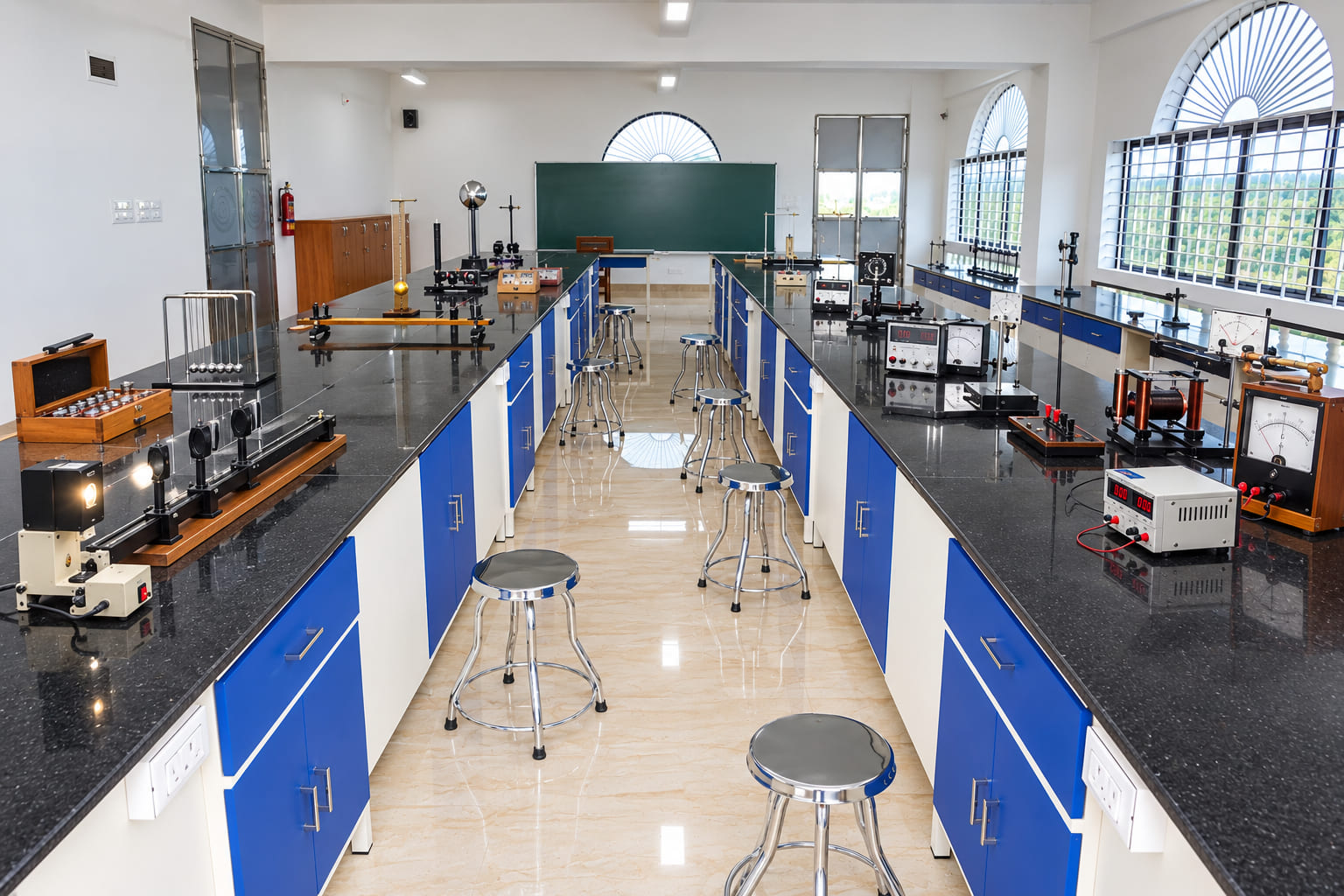
Practical Learning Through Science
The Physics Laboratory at Navajnanasudha Pre-University College provides students with an environment to understand scientific concepts through observation, experimentation and practical learning.
Students can connect classroom concepts with real observations and experiments, helping them develop curiosity, analytical thinking and a deeper understanding of Physics.
- Concept-based learning
- Hands-on experimentation
- Scientific observation
- Analytical thinking
- Problem solving
- Academic preparation
Understanding Concepts Through Experimentation
Physics becomes easier to understand when students connect theoretical concepts with observation, experimentation and practical application.
Mechanics
Explore motion, force, work, energy and other fundamental principles through practical understanding.
Properties of Matter
Understand physical properties of materials and relate theoretical principles with observations.
Heat & Thermodynamics
Develop practical understanding of heat, temperature, energy transfer and related concepts.
Waves & Oscillations
Study wave behaviour and oscillatory phenomena through concepts, observation and experimentation.
Optics
Explore light, reflection, refraction and optical principles through practical learning.
Electricity & Magnetism
Build understanding of electrical and magnetic principles through practical observation.
From Theory to Experiment
Practical work helps students observe scientific principles, apply classroom knowledge and develop confidence in solving problems.
Hands-on Experiments
Students gain practical exposure by observing physical phenomena, carrying out experiments and connecting results with concepts studied in class.
Scientific Understanding
Laboratory activities encourage students to observe, analyse results, ask questions and develop a scientific approach to learning.
Laboratory Experience
The laboratory supports academic learning while helping students develop important scientific and practical skills.
Practical Experiments
Learn through direct observation and experimentation.
Concept Clarity
Connect theoretical knowledge with practical examples.
Observation Skills
Develop careful observation and scientific reasoning.
Analytical Thinking
Interpret observations and understand experimental results.
Problem Solving
Apply scientific principles to solve academic problems.
Faculty Guidance
Receive guidance during practical and academic learning.
Learn • Experiment • Discover
Building curiosity and confidence through practical science.
Skills Developed Through Practical Learning
Physics laboratory learning supports both academic understanding and the development of transferable skills.
Physics for Competitive Examinations
Strong conceptual understanding and regular practice provide an important foundation for higher academic and competitive examination preparation.
Medical Entrance Preparation
Strengthen Physics concepts and problem-solving skills as part of science preparation.
Engineering Entrance Preparation
Develop conceptual clarity, analytical thinking and numerical problem-solving skills.
State Entrance Preparation
Build strong Physics fundamentals through systematic academic preparation.
Practical Physics Learning for PUC Students
The Physics Laboratory at Navajnanasudha Pre-University College, Belthangady, supports students in developing a deeper understanding of the physical principles taught in the classroom. Practical learning allows students to connect theoretical concepts with real-world observations, encouraging curiosity, logical thinking and scientific investigation.
Physics is an important subject for students pursuing the Science stream, particularly those preparing for competitive examinations and further studies in engineering, technology and other scientific fields. Laboratory activities help students understand how physical laws work through observation, measurement, experimentation and analysis.
Physics Laboratory Facilities
A well-organised physics laboratory provides students with opportunities to explore fundamental concepts through practical activities. Laboratory equipment and apparatus are used to demonstrate physical principles and help students understand the relationship between theoretical equations and experimental results.
Practical activities may cover topics such as mechanics, motion, measurements, properties of matter, heat, sound, electricity, magnetism and optics, according to the prescribed PUC syllabus and available equipment.
Students learn to handle apparatus carefully, follow experimental procedures, record observations systematically and interpret their results under the guidance of their subject teachers.
Practical Experiments and Scientific Skills
Physics practical sessions help students develop essential scientific and analytical skills. By carrying out experiments, students learn to make measurements, compare observations with theoretical predictions and understand possible sources of experimental error.
Laboratory work can also help students develop skills in:
-
Accurate measurement and systematic observation.
-
Recording experimental readings and preparing tables.
-
Plotting graphs and interpreting results.
-
Applying mathematical concepts to physical problems.
-
Understanding experimental methods and scientific reasoning.
-
Following laboratory instructions and safety procedures.
These skills support academic learning and help students approach unfamiliar scientific problems with confidence.
Supporting I PUC and II PUC Science Students
The Physics Laboratory complements the Science curriculum for I PUC and II PUC students. Practical sessions reinforce concepts introduced during classroom teaching and provide opportunities to apply theoretical knowledge.
Students preparing for examinations such as KCET, JEE and NEET can benefit from a strong understanding of the underlying principles of physics. Practical learning can strengthen conceptual clarity, although laboratory work complements rather than replaces dedicated examination preparation.
Teachers guide students in understanding experimental procedures, identifying relevant physical principles and relating practical observations to their academic syllabus.
Laboratory Safety and Responsible Learning
Safe laboratory practices are an important part of science education. Students should follow their teachers’ instructions, use apparatus responsibly, handle electrical equipment carefully and maintain an organised working environment.
Learning to observe safety procedures also develops discipline, responsibility and respect for scientific equipment. Students are encouraged to record their observations accurately and complete practical work systematically.
Building a Strong Foundation in Science
At Navajnanasudha Pre-University College, practical science education forms an important part of preparing students for higher education. A combination of classroom instruction, guided laboratory activities and regular academic practice helps students build the knowledge and skills needed for future scientific and technical studies.
Students and parents exploring PUC Science education in Belthangady can learn more about the college’s Science courses, NEET coaching, JEE coaching and KCET coaching.
Discover Science Education at Navajnanasudha Pre-University College
For information about Science admissions, academic facilities and available courses, visit the college’s contact page.
Building a Strong Foundation in Physics
At Navajnanasudha Pre-University College, practical learning complements classroom education and helps students develop knowledge, curiosity, confidence and scientific thinking.